.png)


.png)
The
way people discover information online is changing rapidly. For years,
businesses focused on ranking their websites on Google, attracting organic
traffic, and converting visitors into customers. Search Engine Optimization
(SEO) became one of the most important digital marketing strategies for
building online visibility.
However,
the emergence of artificial intelligence has introduced a new dimension to
online search. Today, users are increasingly asking questions directly to
AI-powered platforms such as ChatGPT, Google Gemini, Perplexity, and Google's
AI Overviews. Instead of browsing multiple websites, they can receive
summarized answers, recommendations, and relevant information within a single
interface.
This
shift has brought a new concept into digital marketing: Generative Engine
Optimization (GEO).
While
traditional SEO focuses on improving website visibility in search engine
results, GEO focuses on making a brand's information discoverable,
understandable, and potentially citable in AI-generated responses.
For
businesses, the question is no longer simply how to rank higher on Google. It
is also how to become a trusted source when potential customers use AI to
research products, compare services, and make purchasing decisions.
Let's
explore how GEO and SEO differ, why both matter, and how businesses can prepare
for the future of online visibility.
What Is SEO and Why Does It Still
Matter?
Search
Engine Optimization (SEO) is the process of improving a website's visibility in
organic search engine results. It involves optimizing website content,
technical performance, site structure, keywords, and authority to help search
engines understand and rank relevant pages.
For
example, when someone searches for "best website development company in
India," Google analyzes multiple signals to identify pages that are
relevant and useful for that search. Websites with strong content, relevant
information, good technical foundations, and credible authority have
opportunities to appear prominently in the results.
SEO
is not limited to adding keywords to website pages. It involves creating a
complete digital experience that helps both search engines and users understand
a business.
A
successful SEO strategy combines technical SEO, keyword research, content
optimization, internal linking, website speed, mobile responsiveness, and
high-quality backlinks. These elements work together to improve discoverability
and build long-term organic visibility.
Businesses
looking to strengthen their search presence can explore professional SEO services by Sirsonite, which include
on-page optimization, technical SEO, keyword research, local SEO, and off-page
optimization.
For
businesses investing in digital growth, SEO remains a valuable channel because
it connects their products and services with people who are actively searching
for solutions.
However,
the search experience is evolving. Users are no longer relying exclusively on
traditional search results to find answers. This is where GEO enters the
picture.
What Is GEO (Generative Engine
Optimization)?
Generative
Engine Optimization (GEO) is an approach to improving how a brand, website, or
its content appears in responses generated by AI-powered search and answer
platforms.
Unlike
traditional search engines that primarily present a list of website links,
generative AI platforms can interpret a user's question, retrieve information
from different sources, and produce a summarized response.
For
instance, a business owner might ask ChatGPT, "What should I look for when
choosing a digital marketing agency?"
An
AI platform may generate a response discussing experience, industry knowledge,
SEO expertise, case studies, pricing, and service quality. Depending on the
platform and query, it may also reference or link to relevant sources.
GEO
aims to improve the likelihood that a business's information will be
discovered, understood, referenced, or cited in these AI-generated experiences.
This
requires more than simply inserting keywords into articles. Content should
communicate information clearly, demonstrate subject expertise, provide
accurate answers, and establish credibility through consistent brand
information across relevant digital platforms.
For
a deeper understanding of this changing search landscape, read our related
article: SEO Is
Changing: How to Get Your Business Mentioned in ChatGPT, Gemini & Google AI.
It
is important to understand that GEO does not guarantee placement in ChatGPT,
Gemini, or other AI-generated responses. These systems use different retrieval
methods and ranking processes, and their outputs can vary between queries.
GEO vs SEO: Understanding the Key
Differences
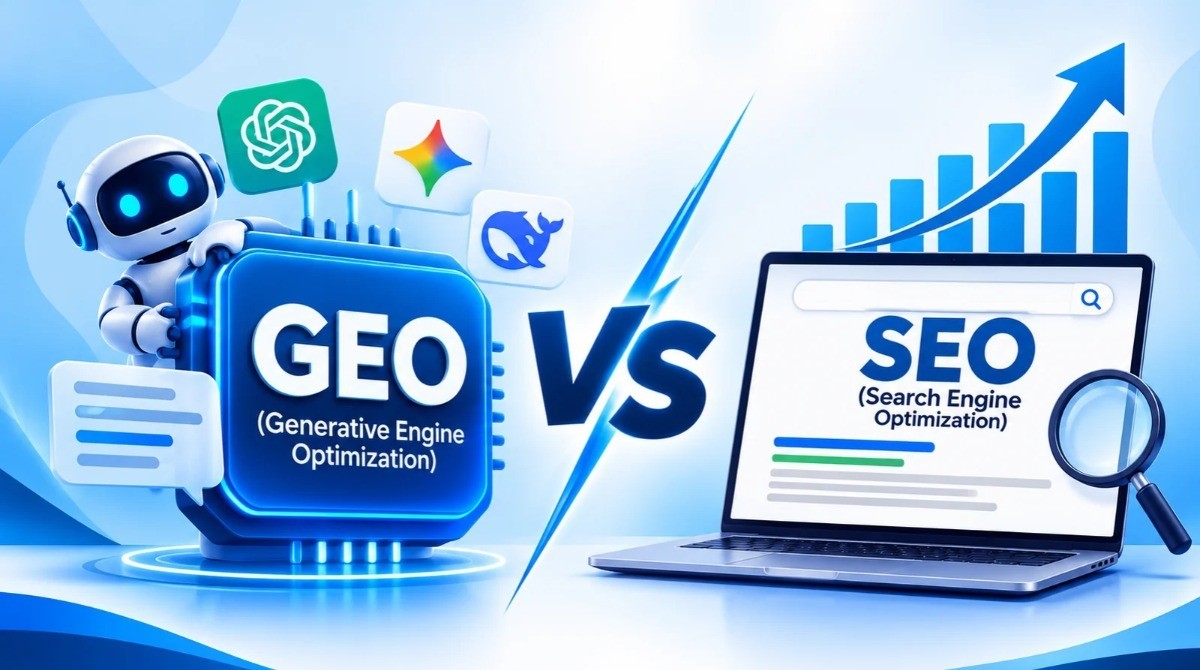
Although
GEO and SEO share a common objective of improving online visibility, they
approach discovery differently.
Traditional
SEO is primarily concerned with helping search engines discover, understand,
and rank web pages. GEO extends this objective to AI-powered discovery
environments, where content may be used as a source for generating answers
rather than simply displayed as an individual search result.
Consider
a company offering website development services.
With
SEO, the company might optimize its service page for keywords such as
"website development company in India" or "custom website
development services." The objective is to appear in relevant Google
search results and attract visitors to the website.
With
GEO, the same company would focus on publishing detailed information that helps
AI systems understand its expertise. This could include articles explaining
website development processes, comparisons of development technologies,
industry-specific solutions, pricing considerations, and answers to common
customer questions.
The
distinction is in the discovery experience. SEO helps a page compete for
visibility in search results, while GEO aims to make useful information
accessible and relevant within AI-generated answers.
Another
important difference is measurement. SEO performance can be evaluated through
organic rankings, impressions, clicks, traffic, and conversions. GEO
measurement is less standardized and may involve tracking brand mentions,
citations, linked references, and referral visits across different AI
platforms.
Neither
approach replaces the other. They serve overlapping but different aspects of
the modern search journey.
Why GEO Is Becoming Important for
Businesses
Consumer
search behavior is becoming more conversational. Instead of entering short
keywords, people increasingly ask detailed questions that reflect their actual
needs.
A
traditional search might be "website design company." A
conversational AI query could be, "Which website design company can build
a professional ecommerce website for a small business with limited technical
knowledge?"
The
second query provides considerably more context. It communicates the user's
requirements, expectations, and potential purchasing intent.
AI-powered
search experiences can interpret this context and generate more detailed
responses. This creates an opportunity for businesses that publish useful,
specific, and trustworthy information.
For
brands, visibility is no longer limited to appearing on the first page of
Google. Being referenced in an AI-generated answer can also introduce a company
to potential customers during their research process.
However,
this does not mean that every business needs to abandon traditional SEO and
invest exclusively in GEO. Google's established SEO guidance remains relevant
to its generative AI search features.
The
practical opportunity is to develop a digital presence that performs across
both traditional and AI-powered discovery channels.
Businesses
can strengthen this presence through a combination of digital marketing services, strategic content
development, brand building, and website optimization.
6 Strategies to Improve Your Website's
GEO and SEO Visibility
1. Create Expert-Led Content That
Answers Real Questions
Content
quality is one of the most important foundations of both SEO and GEO.
Businesses
should move beyond generic articles that repeat information already available
across hundreds of websites. Instead, create content that addresses specific
customer problems, explains complex topics, and provides meaningful insights.
For
example, rather than publishing another generic article titled "Benefits
of Website Development," a development company could create a detailed
guide explaining how to choose the right website architecture for a growing
ecommerce business.
Include
practical examples, industry insights, comparisons, and clear explanations.
This makes content more valuable to readers and provides stronger contextual
information for search systems.
AI
can also support content research, audience analysis, and campaign planning.
Explore our guide on How to Use
AI in Digital Marketing to Get More Leads & Sales in 2026 to understand how
businesses can incorporate AI into their marketing strategies.
2. Build Strong Topical Authority
Publishing
one article about a subject is rarely enough to establish expertise.
Businesses
should create interconnected content around their primary services and areas of
specialization. For example, a company offering SEO services can publish
articles about keyword research, technical SEO, content optimization, local
SEO, AI search, and website performance.
These
articles should connect naturally through relevant internal links.
This
creates a structured content ecosystem that helps visitors explore related
topics and allows search engines to understand the relationship between
different pages.
A
well-organized website also makes it easier for users to move from
informational content towards relevant service pages.
3. Make Website Content Easy to
Understand
AI
systems need to interpret the information available on a website. Clear
writing, descriptive headings, logical page structures, and meaningful
explanations make content easier for both people and automated systems to
process.
Use
headings that accurately describe each section. Answer important questions
directly before expanding into detailed explanations. Avoid unnecessary jargon
and make sure that technical information is supported by understandable
examples.
Structured
data can also help search engines interpret specific information about a page,
business, product, or service when implemented correctly. However, schema
markup is not a guaranteed shortcut to AI citations or search rankings.
The
priority should always be accurate information presented through a technically
sound website.
4. Strengthen Brand Credibility Across
the Web
AI-powered
discovery is not just about individual website pages. A business's overall
digital presence also matters.
Consistent
company information, credible customer reviews, relevant industry mentions,
professional profiles, and useful external references contribute to a stronger
online reputation.
For
example, a web development company should clearly communicate its services,
experience, project expertise, and business information across its website and
relevant professional platforms.
Publishing
useful insights on platforms such as LinkedIn and contributing genuinely
valuable information to relevant industry publications can also help establish
brand recognition.
The
objective should not be to manufacture mentions or backlinks. It should be to
build genuine credibility through useful contributions and consistent brand
communication.
5. Improve Technical SEO and Website
Experience
Even
excellent content cannot perform effectively if a website is difficult to
access, poorly structured, or technically unreliable.
Search
engines need to crawl and index important pages. Visitors also expect websites
to load quickly, work smoothly on mobile devices, and provide a clear
navigation experience.
Businesses
should regularly review their website's indexing, broken links, redirects,
mobile usability, page performance, and internal linking structure.
Your
website's technical foundation plays an important role in both user experience
and search visibility. Read our article on Top 7
Features Every Business Website Must Have in 2026 to understand the
website elements that support better performance and lead generation.
Businesses
planning to upgrade their online presence can also explore Sirsonite's website design
and development services.
A
technically healthy website provides a stronger foundation for traditional
search visibility and eligibility for AI-powered search experiences.
6. Monitor Visibility Beyond
Traditional Rankings
SEO
reporting traditionally focuses on keyword positions, organic traffic,
impressions, and conversions. These metrics remain important, but businesses
should also begin monitoring how their brands appear across relevant AI
platforms.
Test
meaningful customer questions across ChatGPT, Gemini, Perplexity, and Google AI
search experiences. Observe whether your brand is mentioned, whether your
website is cited, which competitors appear, and what types of sources are
referenced.
Repeat
these tests over time using different query variations. AI-generated responses
can change, so a single result should not be treated as proof of consistent
visibility.
Combine
these observations with website analytics, referral traffic, and lead data to
understand whether AI-driven discovery is contributing to business outcomes.
Common GEO Mistakes Businesses Should
Avoid
As
interest in GEO increases, many businesses are searching for shortcuts to
appear in AI-generated responses. However, several popular tactics are often
presented as guaranteed solutions without reliable evidence.
One
common mistake is treating GEO as a replacement for SEO. Strong technical
foundations, useful content, crawlability, and website authority remain
important.
Another
mistake is publishing large volumes of AI-generated articles without meaningful
research, editing, or original insights. Content that simply repeats existing
information provides little value to readers and does not establish genuine
expertise.
Businesses
should also avoid keyword stuffing, artificial brand mentions, irrelevant
backlinks, and excessive use of structured data in the hope of manipulating AI
responses.
Google's
guidance emphasizes helpful, reliable, people-first content rather than
techniques designed primarily to manipulate search visibility.
The
better approach is to invest in quality, accuracy, original insights, and a
strong digital experience.
The Future of Online Visibility: Why
Businesses Need Both GEO and SEO
The
future of digital discovery will not necessarily be controlled by one search
platform or technology. Traditional search engines, AI assistants, social
platforms, and conversational interfaces will continue to influence how people
discover brands and evaluate services.
For
businesses, this means developing a more comprehensive digital visibility
strategy.
SEO
will continue to help websites attract users through organic search results,
while GEO introduces another opportunity to become visible when people seek
information through AI-powered platforms.
Imagine
a potential customer researching website development services. They might first
discover an educational article through Google, ask an AI assistant to compare
development approaches, and eventually visit a company's website to explore its
portfolio and services.
A
business that maintains strong visibility across these touchpoints has more
opportunities to build trust and generate enquiries.
This
is why the next generation of digital marketing will require a combination of
search optimization, high-quality content, technical expertise, brand building,
and a user-focused online presence.
Conclusion
GEO
vs. SEO is not a competition in which one strategy must replace the other. It
represents the evolution of online discovery.
SEO
provides the foundation for search engine visibility, while GEO encourages
businesses to make their expertise and information more accessible within
AI-powered discovery experiences.
Companies
that focus on original content, technical website performance, topical
authority, brand credibility, and meaningful user experiences will be better
positioned to adapt as search behavior evolves.
At
Sirsonite, we believe that successful digital growth starts with
building a strong online foundation. From professional website design
and development
to SEO and
digital marketing solutions, businesses need strategies that connect technology with
measurable business goals.
Ready
to strengthen your online visibility in the AI era?
Explore
Sirsonite and discover how a
strategic digital presence can help your business reach the right audience,
build credibility, and grow online.
Contact Sirsonite today to discuss
your digital growth requirements.
Leave a Reply
Your email address will not be published. Required fields are marked *